The Philosophy of a Konbini
At three in the morning, when the rest of the city has gone dark and silent, the konbini is still lit up like a small planet of its own. You push through the glass doors and a soft electronic chime announces your arrival, not as a customer to be scrutinized, but as a person who needed something and found a place where need is never questioned. The fluorescent lights inside are bright but not harsh, casting a clean white glow over shelves that have been restocked since midnight by workers who will never know your name but have already ensured that your favorite onigiri is waiting in the corner of the refrigerated case.
There is something profound about a space that asks nothing of you. You don't have to buy anything to stand near the hot food case and warm your hands. You don't have to explain why you're awake at this hour, why you're wearing a suit that smells like a fourteen-hour shift, why you're staring at the same shelf of instant ramen for ten minutes without moving. The clerk behind the counter might look up, might offer a quiet "irasshaimase," but there's no urgency in it, no demand. It's simply an acknowledgment that you exist and that this place exists for you.
The konbini near my apartment knows I buy the same salmon onigiri at 7:15 every Tuesday and Thursday morning. The clerk who works those shifts, a young woman with straight black hair who always wears her uniform cap at a precise angle, has never commented on this. She rings up my purchase, offers a small nod, and goes back to whatever task she was performing before I arrived. This is a kind of love. Not the declarative, sentimental kind that we write songs about, but the structural kind, the love built into a system that has decided, at some fundamental level, that your patterns matter, that your presence in the world is worthy of accommodation even when you have nothing special to offer in return.
I've spent years thinking about why Japanese convenience stores feel so different from their counterparts anywhere else in the world. It's not just the quality of the food, though that is undeniably part of it. The onigiri are made fresh throughout the day, rotated out if they sit too long, filled with ingredients that range from simple pickled plum to carefully seasoned salmon that tastes like someone's grandmother prepared it. The fried chicken, karaage, sits in a hot case under warming lights, and when you buy a piece, it's still crisp, still juicy, still hot enough that you have to juggle it between your fingers as you walk out the door.
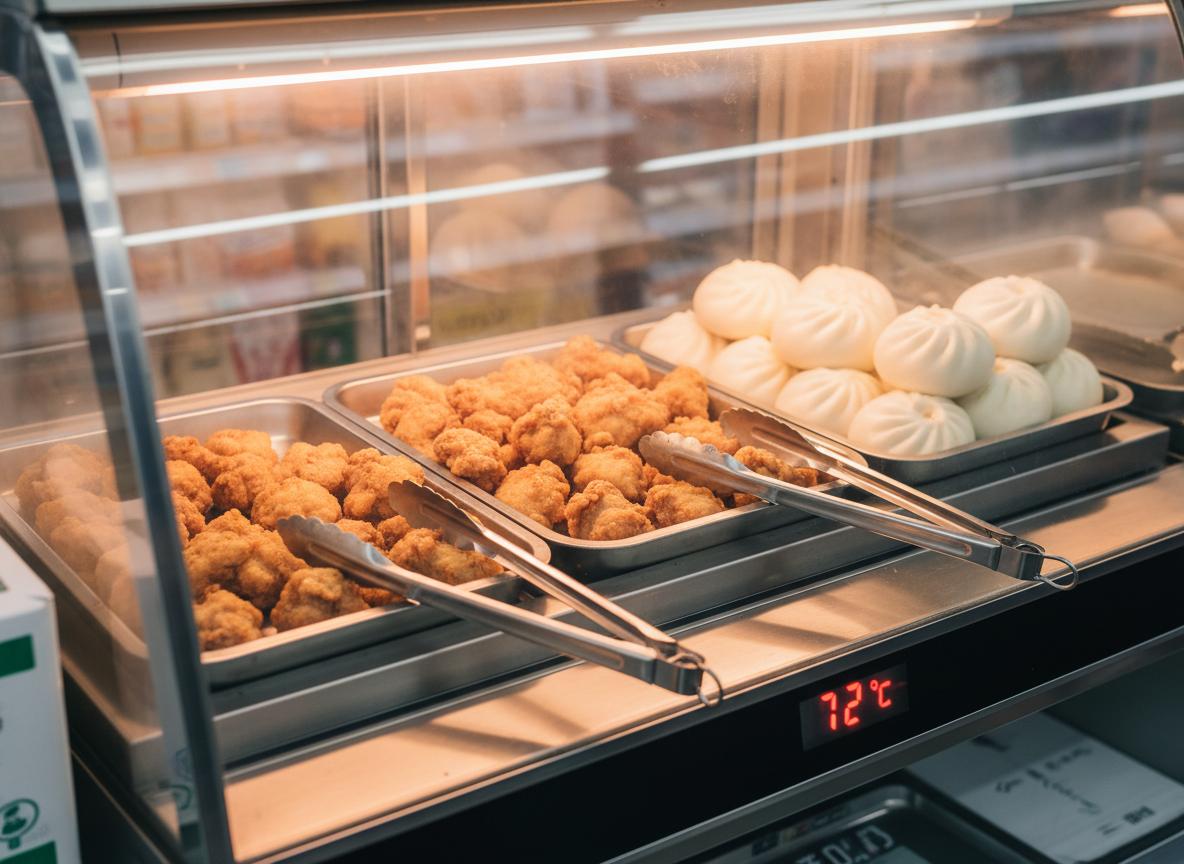
72 degrees Celsius. The temperature of reliability.
But it's not just the food. It's not just the cleanliness, though you'll never find a konbini floor that sticks to your shoes or a bathroom that makes you reconsider your decision to walk through the door. It's something deeper, something that has to do with the way a konbini understands its role in the rhythm of a neighborhood. It is always there. It never judges. It simply works.
Compare this to the convenience stores I grew up with in America. Those stores were places of last resort, lit by buzzing fluorescent tubes that cast a greenish pall over everything and made you feel slightly ill after more than a few minutes. The floors were always sticky with spilled soda. The hot food case, if there was one, contained items of indeterminate age under lights that seemed designed to make them look less appetizing than they already were. The clerks regarded you with suspicion because everyone who entered at 3am was assumed to be up to no good. The whole experience was punitive. It was what you endured when you had no other option.
The Japanese konbini operates on entirely different principles. It is not a place of last resort. It is a place of continuous, quiet usefulness. The neighborhood grandmother comes in at 6am to buy milk. The office worker stops by at noon for a bento box that will be better than anything they could find in a restaurant in most other countries. The student arrives at midnight to photocopy notes and buy a can of hot coffee from the vending wall. The lost tourist finds directions, a bathroom, and a moment of respite from the overwhelming task of navigating an unfamiliar city. Each of these people receives the same treatment, the same clean environment, the same reliable stock of goods.
The precision of a konbini is something you don't notice until you've been in Japan long enough to take it for granted, and then one day you see something that reminds you. The onigiri in the refrigerated case are arranged in a geometry that would satisfy a mathematician. Each triangle sits in its individual pocket, label facing forward, grouped by flavor in rows that run perfectly parallel to the front of the shelf. When one is taken, the remaining items are slid forward to fill the gap within minutes. There is no chaos. There is no rummaging. There is only order, maintained so consistently that it becomes invisible.
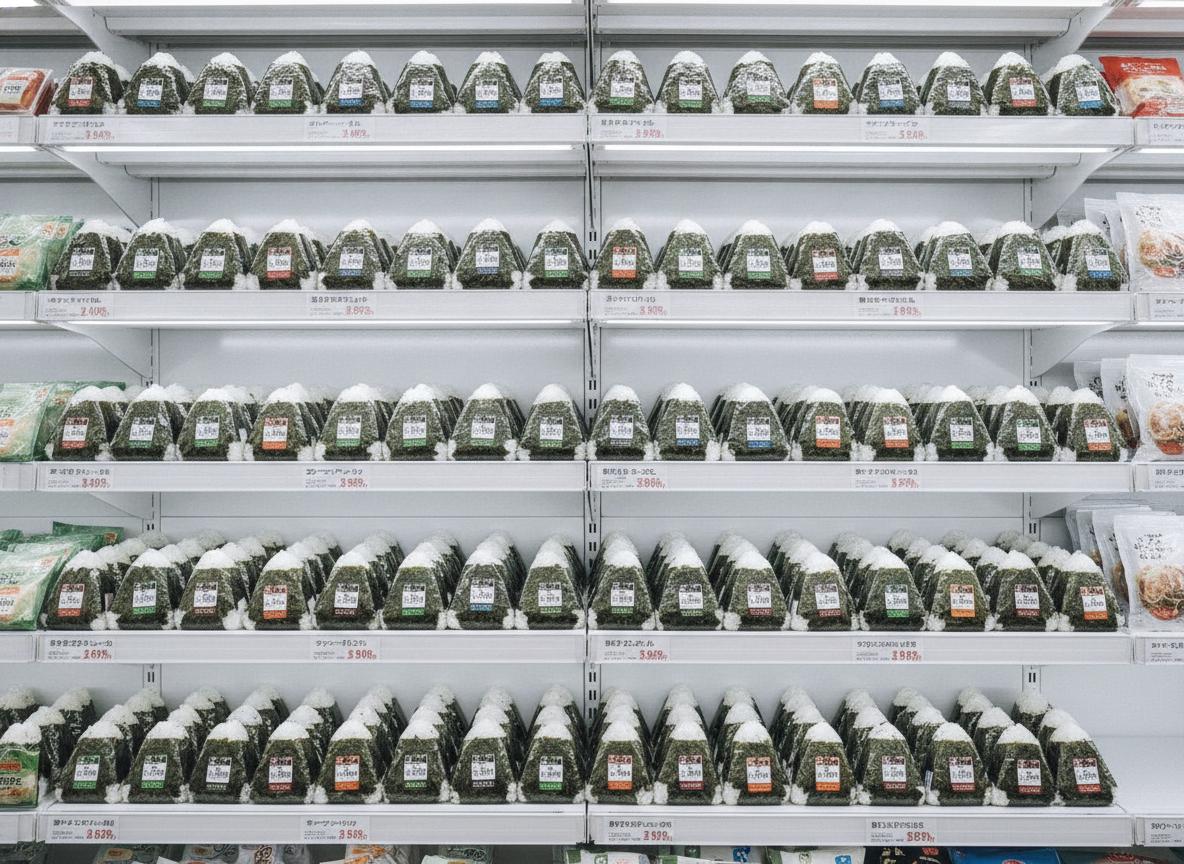
Every triangle in its place. Every label facing forward.
The seasonal rotation of onigiri flavors tells its own story about the Japanese relationship to time. In spring, you might find sakura shrimp or takenoko bamboo shoot. Summer brings ume plum and grilled eel. Autumn has matsutake mushroom and sweet chestnut. Winter offers rich salmon roe and warming pork miso. These aren't random selections. They reflect what's available, what's traditional, what people expect to eat during that particular season. The konbini is not just selling food. It is maintaining a relationship with the calendar, with the agricultural year, with the accumulated culinary memory of an entire culture.
And then there is the community notice board, which exists in almost every konbini I've ever visited. It's usually near the entrance, a corkboard covered in pinned flyers and handwritten notes. Lost cats. Neighborhood festival announcements. Part-time job postings for local businesses. Small advertisements for tutoring services or piano lessons. Someone selling a bicycle. Someone looking for a roommate. The board is unofficial, uncurated, and completely essential. It transforms the konbini from a commercial enterprise into a community hub, a place where the neighborhood talks to itself.
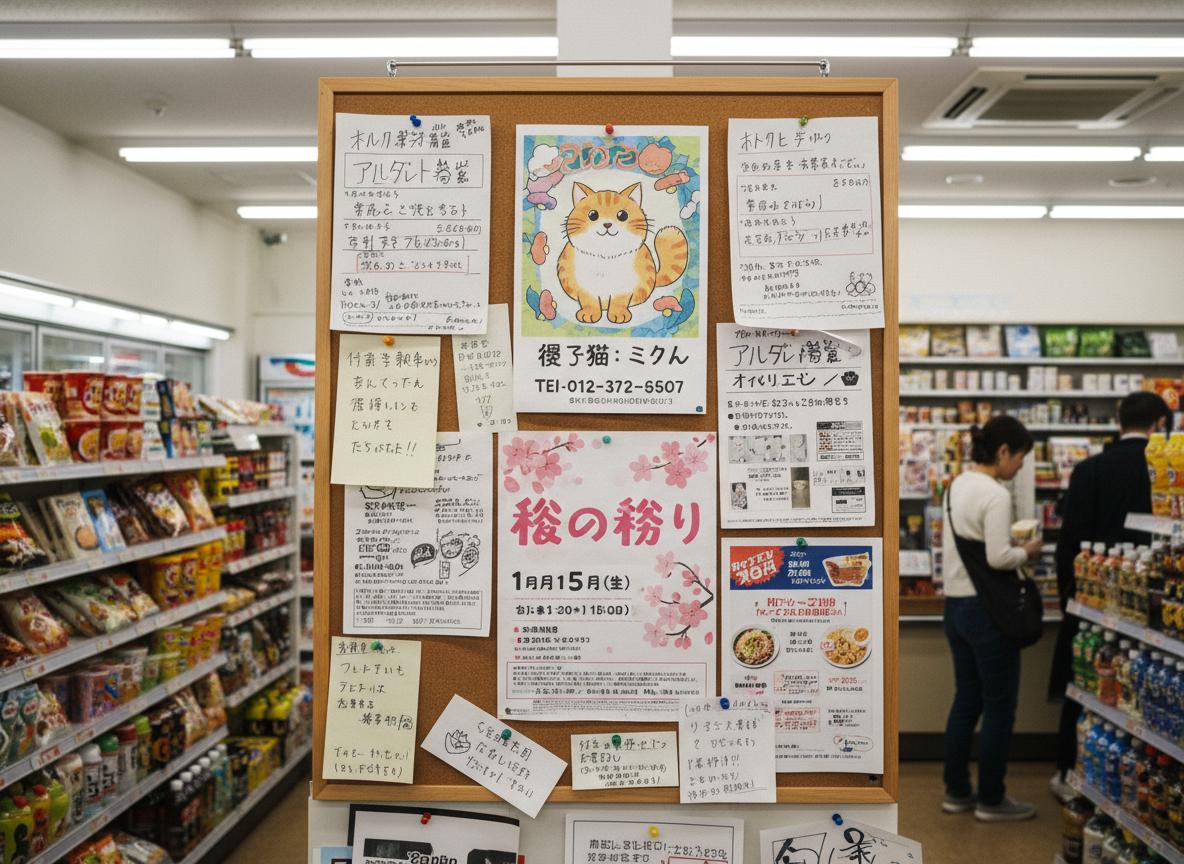
The neighborhood speaks in thumbtacks and paper.
I stood in front of one of these boards for twenty minutes once, reading every flyer, and by the end, I knew more about that neighborhood than I could have learned from weeks of casual observation. I knew that someone named Yuki had lost a ginger cat named Maru three days ago. I knew that the local shrine was having a festival on the weekend and needed volunteers for the food stalls. I knew that a nearby ramen shop was hiring part-time workers and that the hourly wage was 1,100 yen. I knew that a retired math teacher was offering tutoring for middle school entrance exams. This is information that doesn't appear on Google Maps. This is the texture of local life, pinned to a corkboard under fluorescent lights.
The 3am customer at a konbini is a particular kind of person, or rather, a range of particular kinds of people. There's the night worker finishing a shift that started at sunset, buying a beer and a rice ball before walking home to sleep through the morning. There's the student who stayed up too late studying and needs a break, a walk, a change of scenery before returning to textbooks that have started to blur. There's the insomniac who can't sleep and doesn't want to be alone in their apartment, who comes to the konbini not to buy anything specific but to be around the quiet bustle of a place that is awake when everything else is asleep. There's the lost traveler who just got off a late train and needs a bottle of water and directions to their hotel. Each of them finds what they need, and what they need is sometimes just the presence of other humans who expect nothing from them.
How a 120-yen cup of coffee can taste like care is something I've thought about a lot. The coffee at a konbini is not artisanal. It's not single-origin, not hand-poured, not discussed in terms of tasting notes. It comes out of a machine, hot and dark and consistent, into a paper cup that costs extra if you want the size that's actually large enough. And yet. There is something in the reliability of it, in the knowledge that it will be the same today as it was yesterday and will be tomorrow, that produces a feeling of being cared for. Someone made sure this machine was working. Someone refilled the beans. Someone cleaned the nozzles. Someone cared enough about your morning that they did these things before you arrived.
The konbini as a mirror of Japanese values is not a metaphor I came up with myself. It was suggested to me by an old man I met at the Lawson near my train station, a retired salaryman who came in every morning at 7am to buy the same newspaper and the same can of hot coffee. He told me, in the roundabout way that Japanese people sometimes use to explain their own culture to foreigners, that the konbini was Japan in miniature. Everything in its place. No task too small. Cleanliness without fanfare. Service without expectation of gratitude. The whole country, he said, gesturing at the immaculate aisles with his newspaper, works like this.
He's not wrong. The same principles that make a konbini function, the attention to detail, the commitment to order, the understanding that small things matter, are visible everywhere in Japanese life. The train conductor who bows to an empty car before walking through it. The construction worker who wipes down a sidewalk after a day of building. The shopkeeper who wraps your purchase in paper with the care of someone handling a precious object. These aren't performances put on for tourists. They're the natural expression of a culture that has decided, collectively and over a very long time, that doing things properly matters.
But I don't want to make this into something mystical. The konbini is also a corporation. The people who stock the shelves are often working long hours for low pay. The perfection of the onigiri display is the result of corporate training programs and strict quality control standards. The smile you receive at the register is, in part, professional obligation. I'm aware of all this. I don't think the konbini is a magic portal to some ancient Japanese wisdom. I think it's a convenience store that does its job extraordinarily well.
And yet, there is still something. When you're far from home, when you're jet-lagged and confused and everything feels unfamiliar, the konbini is there. When you're lonely at 3am and don't know where else to go, the konbini is there. When you need a copy of your residence card at 11pm because you forgot to make one during business hours, the konbini's copy machine is there, and it works, and it charges a reasonable fee, and no one makes you feel stupid for needing it.
The quiet usefulness of a konbini is, in the end, a form of respect. It respects your needs, whatever they are, at whatever hour you have them. It doesn't ask you to justify yourself. It doesn't require you to be a certain kind of person, to have a certain amount of money, to be engaged in a certain kind of activity. It simply provides. And in a world that increasingly feels like it's trying to extract something from you at every turn, there is something almost radical about a space that asks for so little and gives so much.
I still remember the first konbini I ever walked into in Japan. It was a 7-Eleven in Shinjuku, and I was twenty-two years old and completely overwhelmed by Tokyo. I didn't know what to buy. I didn't know how to use the hot water dispenser for instant ramen. I didn't know that you were supposed to put your money on the little tray by the register instead of handing it directly to the clerk. But I stood in that store, surrounded by a kind of order and abundance that I'd never seen in a convenience store before, and I felt something that I can only describe as relief. I was in a place where things worked. I was in a place where someone had thought about what I might need.
That feeling hasn't changed in all the years since. There are still moments, walking into a konbini at an odd hour, buying something I don't really need just to be in a space that feels reliable, when I feel that same relief. The world outside is complicated and unpredictable. The konbini is not. The konbini is a constant. And there is a kind of love in that constancy, a kind of care built into the architecture of a place that never closes, never judges, never stops being exactly what it is.
The clerk at my neighborhood konbini still doesn't comment on my Tuesday and Thursday salmon onigiri. The hot case still keeps the chicken at exactly the right temperature. The notice board still accumulates its layers of neighborhood news. And at 3am, when the streets are empty and the city is dark, the lights are still on, the chime still sounds, and someone is still there, making sure that everything works.