Train Door Chimes as Lullaby
Every station on the JR network has its own melody, a few seconds of composed notes that play just before the train doors slide shut, and if you ride the same line long enough, you begin to recognize where you are without ever looking up from your book. The chime at Musashi-Itsukaichi station plays a fragment of "Kaerubachi no Uta" because the composer, Shinpei Nakayama, once lived nearby, and when you hear those first few notes through the platform speakers, you're not just being warned that the train is about to depart. You're being told something about the history of the place, about the people who lived here and the music they left behind. It's information delivered as art, and you receive it whether you know the reference or not.
I didn't know about the composer the first time I heard that chime. I just knew that the melody was different from the one at the station before it, and different again from the one at the station after it. Each chime had been chosen for a reason, composed or selected by someone who thought about what this particular place sounded like, what music belonged to this particular patch of ground. Riding the train became, over time, like moving through a museum of small musical compositions, each one lasting only a few seconds, each one tied to a specific latitude and longitude.
There's a particular kind of silence on a Japanese train in the early morning that you won't find anywhere else on earth. It's not the absence of sound, exactly. The wheels make their rhythmic clatter against the rails, a steady percussion that varies in pitch depending on the age of the track and the speed of the train. The ventilation system hums at a constant low frequency, more felt than heard. Every few minutes, a polite recorded voice announces the next station in that distinctive cadence that all train announcers seem to share, rising slightly at the end of the station name as if asking a question. But the silence is human. It is the silence of dozens of people packed into a narrow steel car, and no one is speaking.
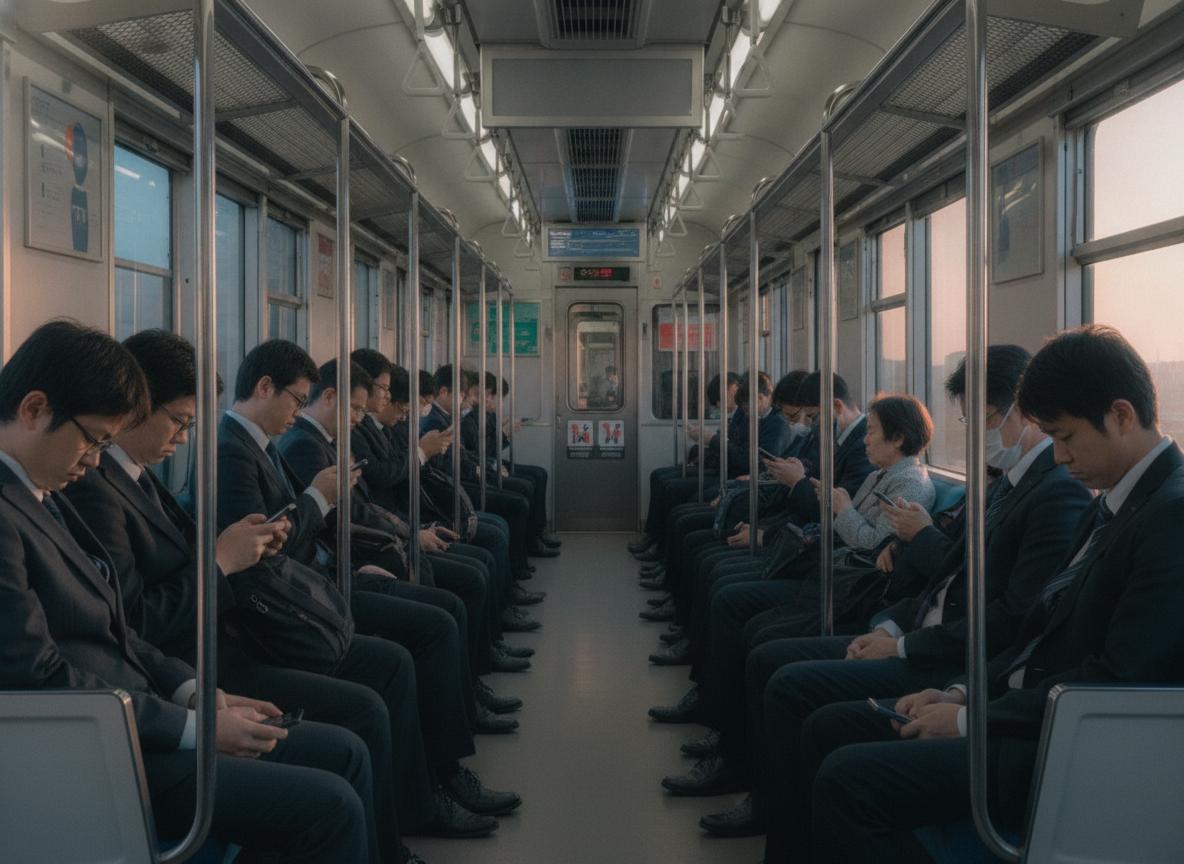
A car full of people, and the only sound is the rails.
No one is eating. No one is playing music without headphones. No one is having a phone conversation, or if they are, they've stepped out into the area between cars and shut the sliding door behind them. The collective agreement to be quiet is so complete, so unquestioned, that after a while you stop noticing it altogether. It becomes like the temperature of the air, something you only think about when it changes.
The first time I experienced this silence, I found it oppressive. I was used to the trains of New York and London, where people talked, argued, laughed, ate sandwiches, played games on their phones with the sound on, where the train was an extension of the street and all the chaos of the street came with it. The quiet of a Japanese train felt artificial to me, like I was in a library or a church, and I kept waiting for someone to break the spell, to speak up, to act normal. But this was normal. This was the agreement. Everyone in this car had signed on to be quiet, not by signing anything but simply by being here, by stepping through the doors and understanding what was expected.
I came to love that silence. I came to depend on it. There were mornings when my life felt chaotic, when I was carrying some worry or disappointment that made the world feel too loud, and I would step onto the train and feel the silence close around me like water. No one was going to ask me for anything. No one was going to tell me about their problems or demand that I share mine. We were all just going where we were going, and the silence was the acknowledgment that we didn't need to perform our journeys for each other.
The priority seats remain empty even when the train is full, and this is something that still moves me every time I see it. They're marked with a simple sticker above the seat back, a green cross on a white background, and they mean: these seats are for elderly passengers, for people with disabilities, for pregnant women, for anyone carrying an infant. And people honor this. Even when every other seat is taken, even when people are standing in the aisle and hanging from the straps, those seats stay empty. Not because there's a conductor enforcing it. Not because there's a fine for sitting there if you're able-bodied. Because everyone understands that this is how it works.
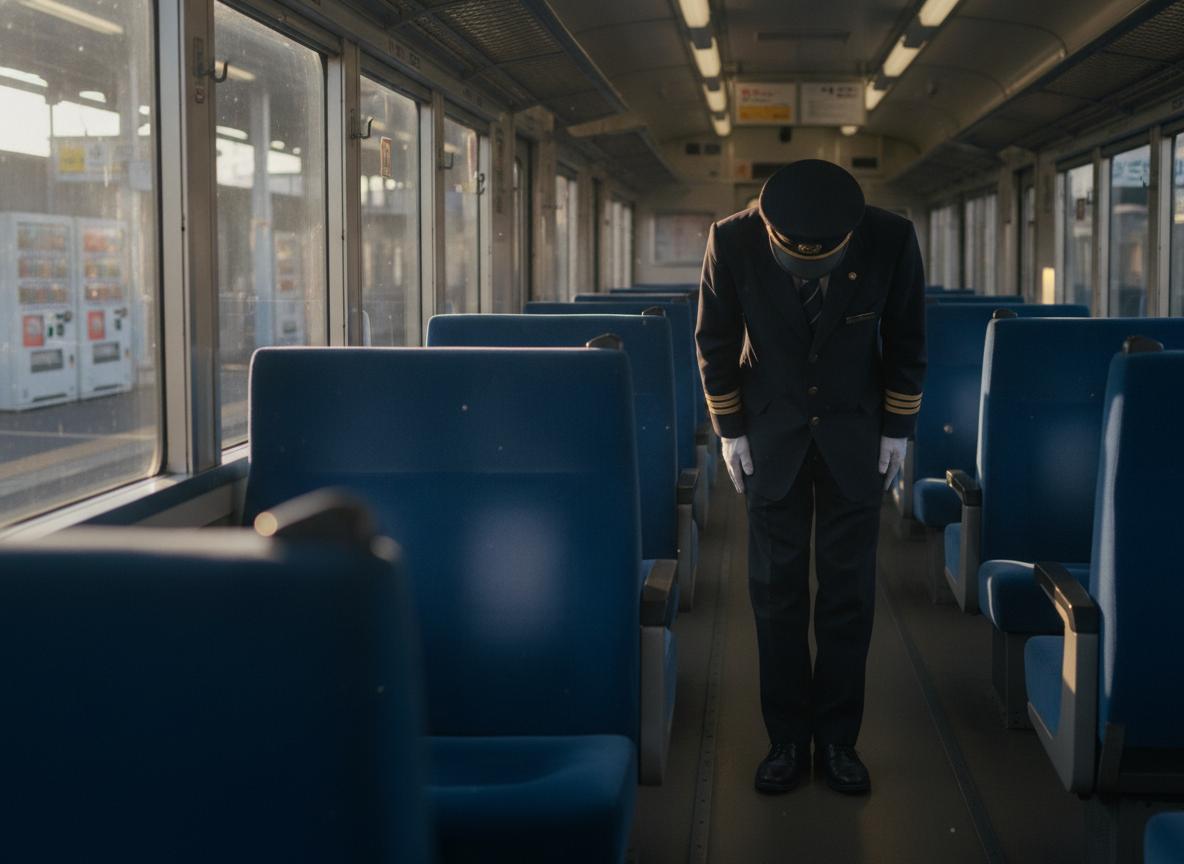
A bow to no one in particular. A bow to everyone.
I've seen teenagers stand rather than sit in those seats. I've seen businesspeople in expensive suits stand with their briefcases at their feet, swaying with the motion of the train, leaving the priority seats open for someone who might need them more. No one has to explain this. No one has to be reminded. It's just part of the grammar of the space, as natural as facing forward or holding on when the train starts to move.
The unspoken rule of not eating on local trains is another of these agreements, and it's one that foreigners often learn about the hard way. I saw a tourist once, a young man from somewhere in Europe, pull out a sandwich on a crowded afternoon train and start eating it with obvious enjoyment. He wasn't being inconsiderate, not intentionally. He just didn't know. But the looks he received from the other passengers weren't angry. They were something more like confusion, the same expression you might have if someone started singing in a library. Not rage. Just a kind of puzzlement that anyone would need to be told.
I caught his eye and shook my head slightly, and he understood immediately. He put the sandwich away, looked around with a new awareness, and I could see him processing what he had missed, the rules he hadn't known he was breaking. He wasn't embarrassed, exactly. He was learning. And the fact that no one had said anything to him, that the correction had come from a look and a gesture rather than a confrontation, was itself a lesson in how this culture handles these things. The group teaches through example. The individual learns through observation.
The platform edge tactile paving, those yellow strips of raised dots and bars that run along the edge of every train platform in Japan, is one of those details that you might never think about unless you need it. But if you're visually impaired, those strips are the difference between safety and danger, between knowing where the platform ends and stepping into empty air. The dots mean caution. The bars mean you're at a staircase or an escalator. The pattern changes to convey information, and the paving is consistent across every platform in the country, so once you learn the language, you can read any station in Japan.
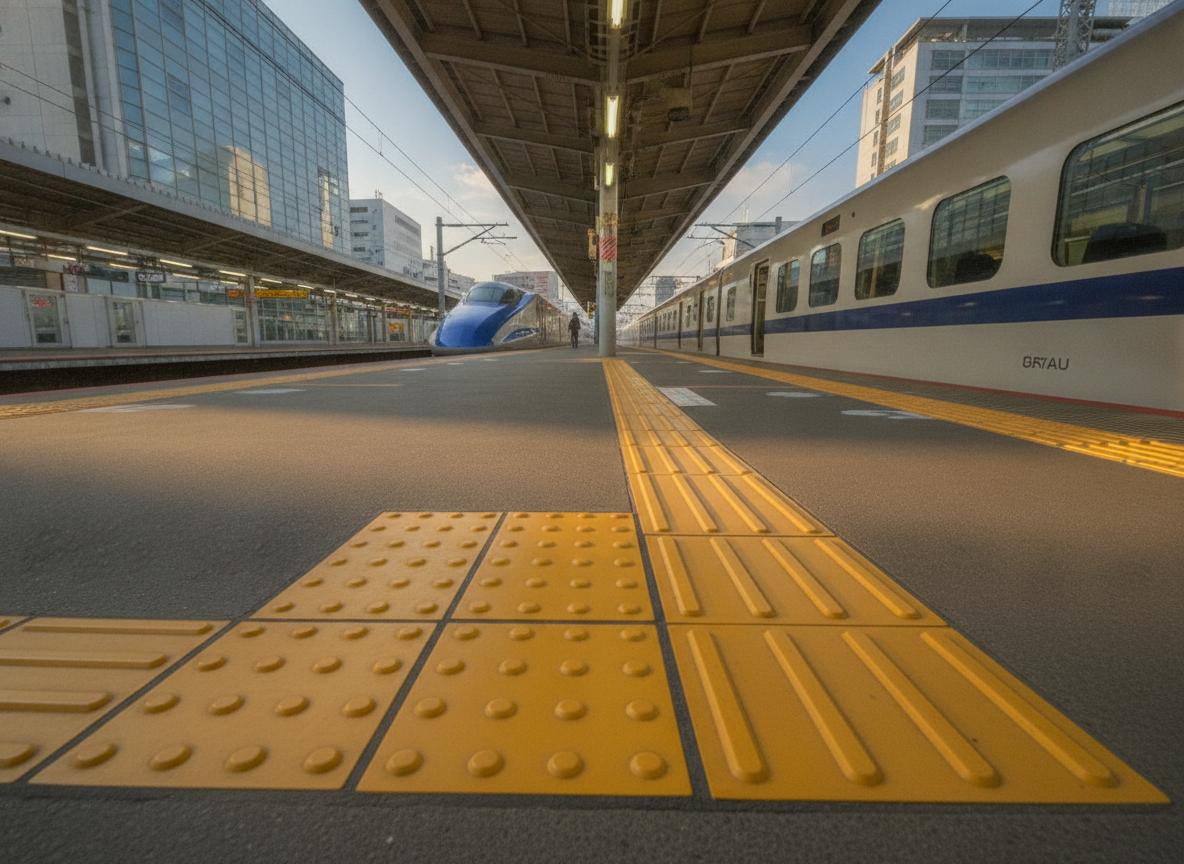
A language of bumps and bars, readable with your feet.
This is what I mean when I say that Japanese trains run on time not through technology but through collective agreement. The tactile paving exists because the society decided that visually impaired people should be able to navigate public transportation safely. The priority seats stay empty because the society decided that certain people need them more. The silence exists because the society decided that the train is a shared space and that quiet is the price of admission. None of these things requires advanced technology. They require a shared understanding of how to behave, and a commitment to behaving that way even when no one is watching.
The bow that conductors give to an empty car is the image I always return to when I try to explain Japanese trains to people who have never ridden them. At the end of the line, when all the passengers have disembarked and the car is truly empty, the conductor walks through and bows before turning around to walk back. There is no one to see this bow. There is no performance aspect to it, no customer to impress. The conductor bows to the empty seats, to the space itself, and in doing so, demonstrates something that goes far beyond professional training.
That bow is an acknowledgment of the service itself, independent of whether anyone is there to receive it. It's a recognition that the work matters even when no one is watching. The conductor isn't bowing to the passengers, because there are no passengers. The conductor is bowing to the ritual of service, to the idea that this is how one behaves in this role, that the standards don't change just because the audience has left. It's integrity made visible, and when you see it, you understand something about why this system works the way it does.
I used to think that Japanese trains ran on time because of superior engineering, and certainly the engineering helps. The Shinkansen is a marvel of mechanical precision, and the entire network operates with a degree of technical sophistication that few other countries can match. But I've been on trains in countries with excellent engineering that don't run on time. I've been on trains in Germany, in Switzerland, in places where the infrastructure is first-rate and yet the experience doesn't feel the same. The difference is not in the tracks or the engines. The difference is in the people.
The trains run on time because the passengers arrive when the schedule says they should arrive. Because the conductors follow procedures that have been refined over decades. Because the maintenance crews perform their checks with thoroughness even when no supervisor is watching. Because the station staff coordinate with precision that comes from repetition and pride. The system works because millions of people participate in its working, every single day, without ever needing to be reminded.
This is what the chimes are really about. They're not just warnings. They're part of the music of a system that works, a system that has been composed over generations by millions of participants who never knew they were composing it. Each chime is a note in a larger piece, and the piece is the sound of a society that has decided, collectively, to move through the world with care and consideration for everyone else who is moving through it at the same time.
I think about this sometimes when I'm on a train that's running through the countryside, fields of rice stretching out on both sides, mountains in the distance, the afternoon sun slanting through the windows and lighting up the silent car in a warm golden glow. Everyone around me is reading or sleeping or looking out the window, and the only sounds are the rails and the occasional chime that tells us where we are. It's peaceful in a way that has nothing to do with relaxation and everything to do with trust. We trust that the train will arrive when it says it will. We trust that the people around us will respect the silence. We trust that when we reach our destination, everything will work the way it's supposed to work.
That trust is not something that can be engineered. It has to be built, over time, through the accumulated actions of millions of people who decide, every day, to do things properly. The train chimes are the soundtrack to that trust. They play for a few seconds, the doors close, and the train moves on to the next station, carrying its cargo of quiet, considerate people through a landscape that changes while the agreements that bind them remain the same.
I still hear the Musashi-Itsukaichi chime in my head sometimes, when I'm far from Japan and the trains where I am don't run on time and no one seems to care. Those few notes, composed by a man who lived near the station decades ago, are still playing, still warning passengers that the doors are about to close, still connecting the present to the past in a way that only music can. The train departs. The platform empties. And somewhere, a conductor bows to an empty car, because that's simply how it's done.